
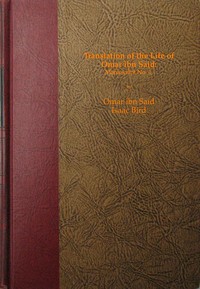
Translation of the Life of Omar ibn Said: Manuscript No. 1 by Omar ibn Said
Have you ever held a document that feels like a direct line to the past? That's what reading Omar ibn Said's autobiography is like. It's not a long book, but every sentence carries the weight of a remarkable life.
The Story
Omar ibn Said was a highly educated Muslim man from modern-day Senegal. In 1807, he was captured, transported across the Atlantic, and enslaved in North Carolina. After an escape attempt, he was jailed and began writing on the walls of his cell in Arabic. This act so intrigued people that he was eventually purchased by a prominent family. Decades later, at the request of that family, he wrote this account of his life.
The narrative moves from his early education in Africa to his capture and life in America. He describes his conversion to Christianity, details his daily work, and offers praise for the family that owned him. On the surface, it reads like a story of peaceful assimilation. But that surface is where the real story begins.
Why You Should Read It
You should read this because it forces you to read between the lines. Omar was a scholar writing for an audience that could not read his native Arabic. He quotes the Bible, but he opens with the Quran's 'Bismillah' (In the name of God). He expresses contentment, yet his descriptions of his lost freedom in Africa are vivid and full of longing.
To me, this isn't a simple story of conversion or gratitude. It's a masterclass in coded communication. It shows how a person can use the expectations of their captors to create a document that preserves their own identity and faith. Reading his careful, polite words, I kept wondering what he wasn't saying, what truths were hidden in the gaps and the script his enslavers couldn't understand. It's a powerful reminder that survival can look like many things, including quiet, intellectual resistance.
Final Verdict
This is a must-read for anyone interested in the hidden layers of American history, the African Muslim experience in the early U.S., or stories of profound human resilience. It's perfect for book clubs because it will spark fierce discussion—was Omar a man making peace with his circumstances, or a subtle revolutionary? It's not a traditional narrative with a plot; it's a historical artifact that challenges you to become an active reader and detective. Be prepared to sit with its complexities long after you turn the last page.
Brian Hill
1 year agoTo be perfectly clear, the pacing is just right, keeping you engaged. Definitely a 5-star read.






Andrew Young
1 year agoI had low expectations initially, however the arguments are well-supported by credible references. Highly recommended.